Answering Service, Virtual Receptionist, or AI: Who Books the Job?

Founder, Avail
A live answering service, a virtual receptionist, and an AI that texts back all promise to catch the calls you miss. Here is what each really does, what it costs, and how to pick.

The job goes to whoever answers first, not whoever answers best. A homeowner with a burst pipe or a dead furnace does not sit and wait. They message a few businesses at once and hire the one who replies, often before you have wiped your hands. The research is blunt about it: firms that reach a new lead within five minutes are far likelier to win the job than firms that wait even half an hour, and most people who cannot reach you never call back. They call the next name on the list.
So the real question is not whether to get help answering your phone. It is which kind of help actually catches those leads while you are on a roof or under a sink. There are three honest options: a live answering service, a virtual receptionist, or an AI that texts people back the second you go quiet. This guide lays all three side by side: what each one does at 7 PM on a Saturday, what each one costs, and how to pick the one that fits your shop.
The short answer
All three solve the same problem, the calls and messages you miss while you work, but they solve it differently.
- A live answering service is a team of remote agents who pick up your phone, take a message or book a basic appointment, and bill you by the minute.
- A virtual receptionist is a more dedicated live person, trained on your business, who answers in your name, screens and books, and costs more for the extra polish.
- An AI text-back assistant is software that answers texts, web chats, and social messages the moment they arrive, turns a missed call into a text conversation, and runs around the clock for a flat monthly fee.
Pick by two things: how your customers actually reach you (call, text, or web form), and what you need to happen the instant you cannot answer.
Why this choice matters more than you think
Picture a one-truck HVAC tech. Call him Ray. It is 6 PM on a Friday and he is on a rooftop with both hands on a manifold gauge when his phone buzzes: a new caller with no heat and a house full of kids. Ray cannot climb down mid-charge to answer. The call rolls to voicemail. By the time he checks it, the homeowner has already booked the company that picked up.
That is the moment this whole decision is about. And the numbers say the moment is expensive.
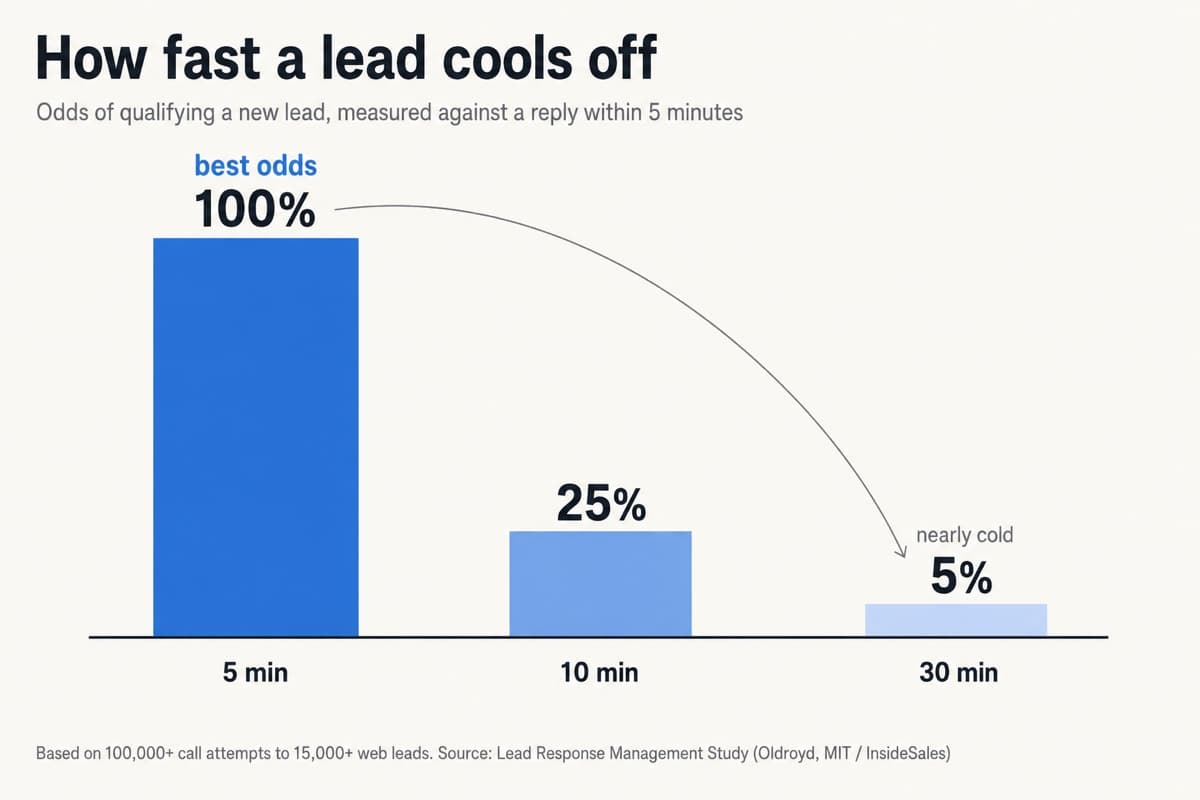
Speed decides who wins. The InsideSales and MIT Lead Response Management Study tracked more than 100,000 call attempts to over 15,000 web leads across six companies. It found that reaching a lead within five minutes makes you roughly 100 times likelier to connect, and 21 times likelier to qualify it, than waiting just 30 minutes. Harvard Business Review, auditing thousands more companies, found that firms responding within an hour were seven times likelier to qualify a lead than those that waited an hour longer. The window is minutes, not hours.
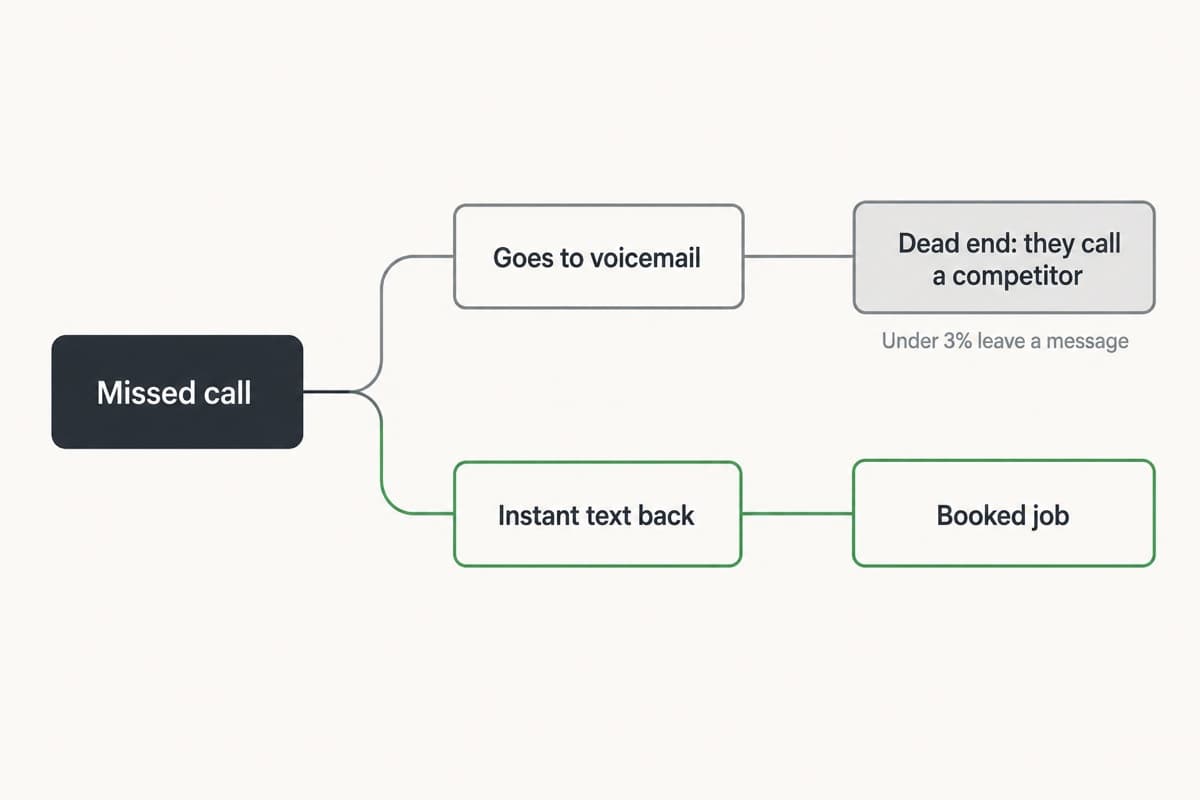
Voicemail is a dead end. Fewer than 3% of callers sent to voicemail actually leave a message, according to call-analytics firm Invoca. The other 97% hang up. And when they cannot reach you, they do not wait. They call the competition.
Ray's problem is not that he is bad at his job. It is that he is good at it, which means his hands are full exactly when the phone rings. Every option below is a different way to make sure that no-heat call still gets an answer.
The three ways to cover the calls you miss
A live answering service
A live answering service is a call center that answers your phone under your business name. The agents are real people, usually working from a shared pool and following a script you provide. They greet the caller, take a message, answer a few basic questions, and maybe schedule a simple appointment, then pass the details to you.
At 7 PM on a Saturday: a trained human picks up, so an anxious caller hears a real voice. That is the strength. The catch is that a shared agent does not know your trade the way you do, so anything past the script becomes "I'll have someone call you back."
It fits shops with more live-phone volume than they can staff. Its blind spot is everything that is not a phone call: the texts, Facebook messages, and web-form leads pile up untouched in other inboxes, and the meter runs on every minute.
A virtual receptionist
A virtual receptionist is the premium version of the same idea. Instead of a shared pool, you get a more dedicated person or small team trained on your business, answering in your name and acting like an extension of your front desk. They screen calls, book appointments in your calendar, handle intake, and warm-transfer the ones that matter to you.
At 7 PM on a Saturday: you get a polished, on-brand human who can actually do things — book the job, answer a deposit question, route an emergency — not just scribble a message. That polish is what you pay extra for, and it earns its keep where calls are high-value and the caller experience is part of the brand: law offices, medical, high-ticket trades.
The rub is that it is the priciest option and still a phone service at heart. The channels where a growing share of leads now start — text and social and web — usually sit outside what it covers.
An AI text-back assistant
An AI text-back assistant is software instead of a switchboard. It answers your messages, texts, web chats, and social DMs, in seconds and around the clock, and it turns a missed call into a text: when a call goes unanswered, an automatic message goes right back out so the conversation keeps going. It answers common questions, qualifies the job, books the appointment, and escalates to you when something needs a human.
A quick clarification, because "AI" gets used loosely. Some AI tools answer the phone with a synthetic voice; others work over text. This guide focuses on the text-first kind, because texting is where most small shops actually lose leads and where customers respond fastest.
At 7 PM on a Saturday: the reply is instant, every time, on the channel the customer used. No hold music, no voicemail, no "we're closed." If the job is a true emergency, a good assistant flags you immediately instead of guessing.
Will customers put up with a bot? More than you would think, with one condition. 64% of consumers say they are comfortable texting with an AI, and 69% say the option to reach a human when they need one makes them far more comfortable. In the same research, 8% could not even tell whether they had been texting a bot or a person. So the AI is fine for the first reply, as long as a human is one message away.
Its home turf is message-driven and ad-driven shops, and anyone who wants 24/7 coverage for a fixed price with no per-minute meter. Its limit is the live voice: it does not put a human on the phone, so for the caller who insists on talking to a person that second, it answers with a text instead, which puts all the weight on a good escalation path.
The comparison, side by side
A live answering service uses shared remote agents, covers phone calls, and bills per minute or per call. A virtual receptionist uses a dedicated, trained live person, covers phone calls (some add chat), and costs more. An AI text-back assistant uses software with handoff to you, covers texts, web chat, social DMs, email, and missed calls turned into texts, and charges a flat monthly subscription.
Speed: answering services and virtual receptionists are as fast as an agent is free; an AI is instant, every time. Hours: live services offer business hours or 24/7 for more; virtual receptionists usually cover business hours; an AI is always on.
Best for: a live answering service fits heavy live-phone volume. A virtual receptionist fits high-value calls where a branded human matters. An AI fits message and ad-driven leads, catching missed calls.
What each one really costs
Price is where the three really separate, and where the sticker number hides the real one.
- Live answering service: billed per minute (about $1 to $2 a minute) or a monthly plan with bundled minutes plus overage. Typical range for a small shop is $50 to $500 a month, rising with call volume.
- Virtual receptionist: billed per minute or per call at a higher rate, or a monthly plan. Typical range is $200 to $800 or more a month.
- AI text-back assistant: flat monthly subscription, no per-minute charge.
- Hiring in-house: median receptionist wage is about $37,230 a year before benefits.
Per-minute billing punishes your best months. With a live service, you pay for every minute, including the ones spent on wrong numbers, spam, and a chatty caller who was never going to book. When a storm rolls through or the first heat wave hits, your call volume spikes and so does the bill. A flat monthly fee does the opposite: your busiest week costs the same as your slowest.
In-house looks cheap until you add it up. A front-desk hire is not just the wage. It is benefits, payroll taxes, training, and the fact that the seat is empty nights, weekends, and holidays, which is exactly when the emergency calls come.
Compare them by cost per booked job, not the monthly sticker. A furnace replacement that clears about $900 in profit pays for a month of any of these options, with room to spare. So the real question is which one saves the most jobs for the money.
Which one fits your shop?
Match the tool to how you actually run. Start with where your leads come from and how often you are unreachable.
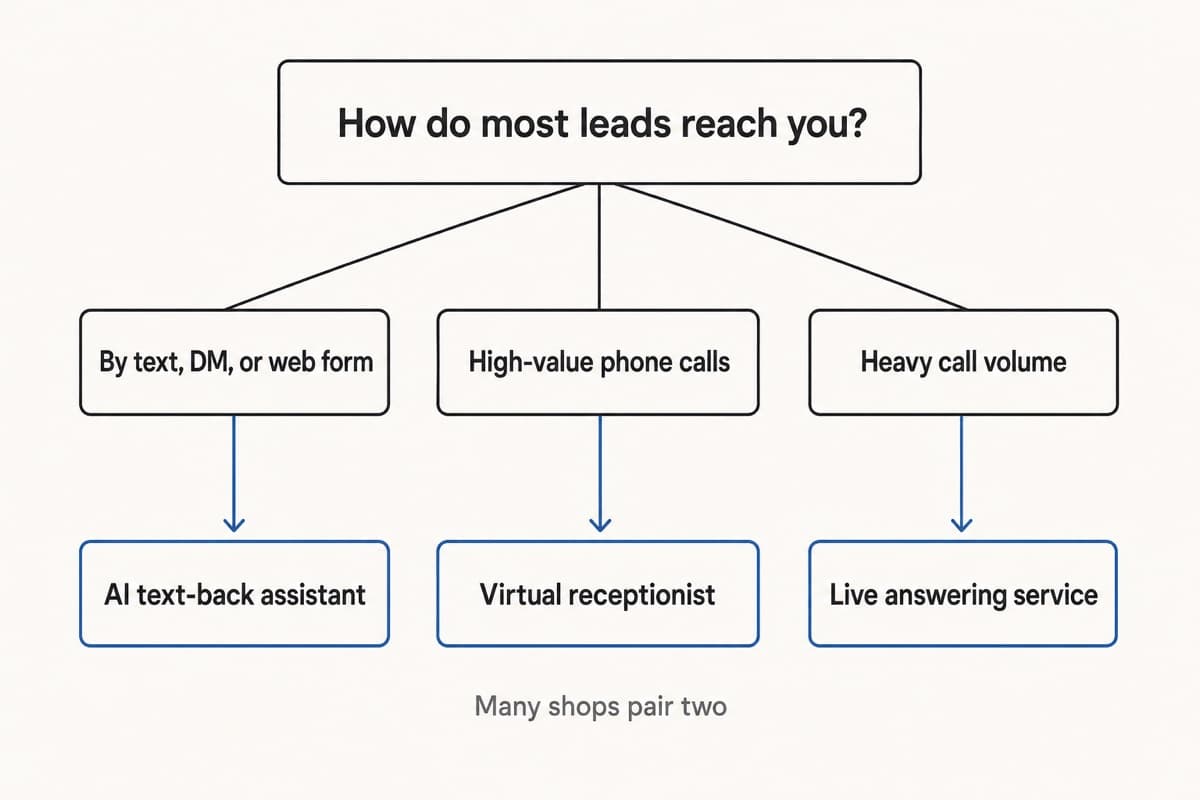
The one-truck solo operator: You are the whole company, so your problem is coverage — you cannot answer and do the work at the same time. You need instant first contact that does not cost a salary. An AI text-back assistant fits best, because it answers every channel the moment you go quiet and only pulls you in when a job is real.
A shop with a few crews: You have some phone volume and maybe someone half-watching the inbox. A live answering service can absorb daytime overflow, but the after-hours and message leads still leak. Many shops this size pair a text-back assistant for messages and missed calls with a light phone plan for the daytime spillover.
Emergency trades, heavy after-hours: Plumbing, HVAC, electrical, restoration. Your best jobs arrive nights and weekends when no receptionist is at a desk. What you need is 24/7 coverage that responds fast and can flag a true emergency to you. A live answering service can do that if you are willing to pay for overnight staffing; an always-on automated reply can do it for a flat rate.
Ad-driven and web-heavy: If you run Meta or Google ads, your leads arrive as messages and form fills, from a phone, after hours, expecting an answer now. A phone-only service never even sees them. This is the clearest case for a text-first assistant that answers Messenger, SMS, and web chat the instant an ad lead lands.
The mistake almost everyone makes
Most owners shop this decision on the wrong two axes: price and "human versus robot." They ask which service is cheapest, or whether a bot will embarrass them. Both miss the point.
The two axes that actually decide whether you book the job are speed and channel. Speed, because whoever answers first usually wins, and the gap is measured in minutes. Channel, because a tool that only answers the phone is blind to the texts, DMs, and web forms where a growing share of leads now start, and it is useless for the missed call that never becomes a voicemail.
Reframe it and the picture changes. The best human receptionist in the world still loses the lead if she is on another call for four minutes. And a caller who reaches voicemail is not a message waiting for you, he is a customer already dialing someone else. The winner is not the fanciest answer, just the fastest one on the channel the customer actually used.
Now, the honest counterpoint: plenty of people still prefer to call, especially in a real emergency, and a warm human voice matters for high-ticket, high-trust work. So weigh how your own leads actually arrive. If they come mostly as calls from people who want a voice, a live answering service or receptionist is the better spend. If they come as texts, DMs, web forms, and after-hours missed calls, an instant automated reply catches what a phone line never sees. Plenty of shops need both. The point is to match the coverage to how your leads actually reach you, not to the option with the loudest marketing.
Back to Ray. With an assistant texting back the second his call went to voicemail, that no-heat homeowner gets an instant "Got your message, sorry we missed you, is this the unit that's not heating? We can come tomorrow morning, want me to hold the slot?" while Ray finishes on the roof. The lead that used to walk is now booked. Nothing about Ray got faster. Something just answered for him.
The bottom line
The job goes to whoever answers first, not whoever answers best. All three options exist to make sure someone answers when you cannot, and any of them beats a voicemail nobody checks.
So decide with two questions. How do your customers actually reach you, and what has to happen the second you cannot answer? Answer those honestly and the fit usually picks itself: a live service or receptionist if your world is high-value phone calls, a text-first assistant if your leads arrive by message and ad and after hours, or both if you truly straddle the two.
Ray did not need to work later or answer faster. He needed something to answer for him. Whatever you pick, pick the one that makes sure the next burst-pipe call at 9 PM ends with a booked job, not a voicemail nobody hears.
Frequently asked questions
- What is the difference between an answering service and a virtual receptionist?
- Both are live humans answering your phone, but the depth differs. An answering service uses shared agents who mostly take messages and do light booking from a script. A virtual receptionist is more dedicated and trained on your business, so they answer in your name, screen calls, book into your calendar, and transfer the important ones, for a higher price.
- How much does an answering service cost per month?
- For a small business, a live answering service commonly runs somewhere from about $50 to $500 a month, depending on call volume. Most bill by the minute (roughly $1 to $2 a minute) or sell monthly plans with a bundle of minutes plus overage fees. Virtual receptionists cost more, often several hundred dollars a month and up.
- Can an AI really answer my customers without annoying them?
- For the first reply and routine questions, yes, as long as a human is easy to reach. Research shows 64% of consumers are comfortable texting with an AI, and comfort jumps when they know they can reach a person. The trick is a clean handoff: let the AI answer instantly and book the easy stuff, and pull you in for anything real.
- What actually happens to a missed call with an AI text-back?
- Instead of dumping the caller into voicemail, the system sends an automatic text right back, something like "Sorry we missed you, how can we help?" That matters because fewer than 3% of people leave a voicemail, but most will answer a text. The missed call becomes a live conversation you can still win.
- Do I still need a phone number people can call?
- Yes. Keep your number and let people call it. A text-back assistant works alongside your line — it catches the calls you miss and answers the texts and messages — rather than replacing the phone. Customers who want to call still can, and the ones you cannot reach still get an instant answer.
- Is it cheaper than hiring a receptionist?
- Almost always, once you count the full cost. A receptionist earns a median wage of about $37,230 a year before benefits, payroll taxes, and training, and the desk sits empty nights and weekends. An answering service or AI assistant covers those hours too, for a fraction of a salary.
- What if the job is a real emergency and needs me right now?
- That is what escalation is for. A good setup answers the customer instantly, then alerts you the moment it spots an emergency, by text or push, so you can jump in. The AI handles the routine and buys you a few minutes; you handle the calls that truly cannot wait.
- Which option is best for a solo operator?
- For a one-person shop, an AI text-back assistant usually wins, because your real problem is being in two places at once. It answers every channel instantly while you work, books the easy jobs, and only interrupts you when it needs to, without adding a payroll line.
Never miss another job
See how Avail answers, qualifies, and books for your business — 24/7.
Talk to Us